Hahahaha. So here's Disney's anti-nazi propaganda. It tells the story of Sleeping Beauty a couple of decades before Walt made Sleeping Beauty. The witch is awesome, like from Snow White (and not like Maleficent at all). It makes me want to see this version of Sleeping Beauty... until it ends up an Opera singer and Hitler. =^)
- TAE
Showing posts with label Racism in Animation. Show all posts
Showing posts with label Racism in Animation. Show all posts
Thursday, February 04, 2010
Walt Disney Cartoon - Hitler's Children Education For Death

Banned Cartoons (includes Disney stuff)
Lots of good stuff here. It includes the Academy Award winning Donald Duck short and the 7 Dwarves peddling war bonds.
I am not racist against anyone, culture, religion, or race. I just thought that people would like to see ways that animators used to use types of propaganda and stereotypes in their cartoons during a time when it was accepted and "normal."
Enjoy!
- TAE
Sunday, December 14, 2008
Racism in Animation 2 (Christmas Cartoon 20) - Santa's Surprise (1947)
Here is Santa's Surprise, an old 1947 animation from Paramount studios.
This shows how sterotypes in those times weren't intended to be offensive, although they easily could be.
Here you have everything stereotypical, including a black boy who shines shoes, and a Chinese boy who does laundry (and has a very stereotypical accent).
"This is the first appearance by Little Audrey. She would make a cameo in a Popeye cartoon "Olive Oyl For President" early in 1948, before inaugurating a new series of her own in June 1948.
"Like so many things from the 1940s, this cartoon is full of what would today be considered offensive racial stereotypes in what was probably an attempt at diversity. Check out the design on the black and Chinese kids, especially. "
More on this movie (above quotes from here):
http://www.imdb.com/title/tt0152285/
This animation was created by Famous Studios, which was the successor to the Fleischer Brothers studio.
"Famous Studios, later renamed Paramount Cartoon Studios, was the animation division of the Hollywood film studio Paramount Pictures from 1942 to 1967. Famous was founded as a successor company to Fleischer Studios, after Paramount acquired Fleischer Studios and ousted its founders, Max and Dave Fleischer, in 1941...
"Fleischer Studios was a successful animation studio responsible for producing successful cartoon shorts starring characters such as Betty Boop and Popeye the Sailor. The studio moved its operations from New York City to Miami Beach in 1938, following union problems and the start of production on its first feature film, Gulliver's Travels (1939). While Gulliver was a success, the expense of the move and the expanded staff required to produce the feature created finance problems for the Fleischer Studios. The studio depended upon advances and loans from its distributor, Paramount Pictures, in order to continue production on its short subjects and to begin work on a second feature, Mister Bug Goes to Town.
"Compounding the problems the studio was facing was the fact that the studio's co-founders, brothers Max and Dave Fleischer, were becoming increasingly estranged, and not speaking to one another due to disputes. On May 21, 1941, Paramount assumed full ownership of Fleischer Studios, and had the Fleischer brothers submit signed letters of resignation, to be used at Paramount's discretion. Following the unsuccessful release of Mister Bug in December 1941, Dave Fleischer, no longer able to cooperate with Max, left Miami for California, where he was hired to run Columbia Pictures' Screen Gems animation studio. Paramount responded by producing the letters of resignation, severing the Fleischer brothers from control of their studio.
"Paramount renamed the studio Famous Studios, and although they had ownership of the company, it remained a separate entity. Four top Fleischer employees were promoted to run the animation studio: business manager Sam Buchwald, storyboard artist Isadore Sparber, animator Dan Gordon, and Max Fleischer's son-in-law, head animator Seymour Kneitel. Buchwald assumed Max Fleischer's place as executive producer, while Sparber, Kneitel, and Gordon shared Dave Fleischer's former responsibilities as supervising producers and credited directors. Gordon remained only briefly before departing after 1943. Although the Fleischers left the studio at the end of 1941, Famous Studios was not officially incorporated until May 1942, after Paramount's contract with Fleischer Studios had formally run its course.
The Famous Studios cartoon series include:
Popeye the Sailor (inherited from Fleischer Studios, 1942 – 1957)
Superman (inherited from Fleischer Studios, 1942 – 1943)
Noveltoons (1943 – 1967)
Little Audrey (1948 – 1959)
Little Lulu (1943 – 1948)
Screen Songs (1947 – 1951; originally produced by Fleischer Studios 1929 – 1938)
Casper the Friendly Ghost (1950 – 1959)
Kartunes (1951 – 1953)
Herman and Katnip (1952 – 1959)
Modern Madcaps (1958 – 1967)
Jeepers and Creepers (1960)
The Cat (1961)
Swifty and Shorty (1964 – 1965)
Honey Halfwitch (1965 – 1967)
Merry Makers (1967)
GoGo Toons (1967)
Fractured Fables (1967)
More on Famous Studios (above quotes from here):
http://en.wikipedia.org/wiki/Famous_Studios
More Racism in Animation...
Racism in Animation 3 - Pluto's Dream House (1940):
http://theanimationempire.blogspot.com/2008/01/racism-in-animation-3-mickey-mouse-in.html
Racism in Animation 2 - Santa's Surprise (1940):
http://theanimationempire.blogspot.com/2007/12/racism-in-animation-2-christmas-cartoon.html
Racism in Animation 1 - Fantasia (1940):
http://theanimationempire.blogspot.com/2007/12/racism-in-animation-1-fantasia-bans.html
We're posting Christmas cartoons every day until Christmas!
- TAE
Tuesday, May 27, 2008
Racism in Animation 13 - Bugs Bunny: War Bond Drive
Notice how Bugs looked a little different and Elmer looked very different.
Bugs does a Sammy Davis Jr. impression.
---------
Bugs Bunny goes to a military base where he meets up with a mischievous gremlin who gets the better of him. Animation by Rod Scribner, music by Carl W. Stalling. Produced in 1943.
Bugs Bunny: Falling Hare
- TAE
Tuesday, May 13, 2008
Racism in Animation 12 - Popeye: Seein' Red, White 'n' Blue (1943)
"Popeye's banned toon, since 1943, with an anti-japanese message, because of the Pearl Harbor´s attack in 1941.
Hitler gets beat down too."
- TAE
Wednesday, March 26, 2008
Racism in Animation 11 - Donald Duck: Der Fuehrer's Face (1943)
Disney cartoon showing Donald duck as a Nazi.
A 1943 Anti-nazi propaganda film made by Walt Disney.
At this point in time, Donald Duck was the most popular Disney character.
- TAE
-------------
France fought America back by making fun of these cartoons...
Nimbus Libere (1944)
Thursday, March 20, 2008
Racism in Animation 10 - Popeye: You're a Sap Mr. Jap (
Popeye was extremely popular at the time.
"Cartoons like this were shown in theaters coast to coast in order to build up moral and our fighting spirit. Racist or not It truely reflected the american view of japanese at that time. Remember that while seeking a peace plan, they also sent an armada to attack us if we didn't agree with their emperialistic goals."
- TAE
-------------
France fought America back by making fun of these cartoons...
Nimbus Libere (1944)
Sunday, March 16, 2008
Racism in Animation 9 - Betty Boop: Making Stars
Classic Betty Boop cartoon that was banned from TV due to racist assumptions.
From the 1930s.
- TAE
Friday, March 14, 2008
Wednesday, March 12, 2008
Racism in Animation 7 - Tex Avery: Blitz Wolf
Tex Avery takes his spin on the successful and cute Disney shorts about the Three Little Pigs and makes it into racist anti-German war propaganda. Everybody was doing it, even Tex.
- TAE
Sunday, March 09, 2008
Racism in Animation 6 - Looney Tunes: Tokio Jokio (1943)
After the Japanese bombed the Pearl Harbor, all gloves were off in making fun of the Japanese with animation.
- TAE
Thursday, March 06, 2008
Racism in Animation 5 - Wot A Night (1931)
1931 - Van Beuren Studios - Wot A Night
I like this one because the left character on frame 00:33 looks like he's right out of the Simpsons! LOL
- TAE
Tuesday, January 08, 2008
Racism in Animation 4 - Disney's The Martins and the Coys (1946)
"When the current powers that be final decided to release Make Mine Music, for some reason they found this segment to politically inocorrect to be included in it's release. Here is the Martin's and the Coys in all it's Political Incorrectness."
The Martins and the Coys was a Disney short that was directed by legend Jack Kinney and produced by Walt Disney himself. It in 1946 during the war time when it was better business for Disney to put his full-length films on hold in order to release individual shorts together as a full-length movie and then individually as shorts (to get twice the distribution money out of them).
It was released as the full movie, Make Mine Music.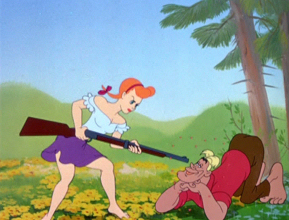
The following description is from IMDB:
http://www.imdb.com/title/tt0038729/
"THE MARTINS AND THE COYS carry on their senseless, bloody feud until only one member of each family is left alive.
"Originally a segment of MAKE MINE MUSIC (1946), this Disney short is perhaps deservedly obscure today, as it is a serious lack of good taste & common sense to continue the stereotyping of Appalachian 'mountain men' as lazy, drunken, thieving & murderous. The historical basis for the plot is the infamous Hatfield-McCoy Feud which livened up portions of the West Virginia - Kentucky border in the late 1800's. The King's Men provide the singing narration with the requisite amount of twang."
"Disney released this feature on video for the first time ever in the spring of 2000. One time, I was looking at reviews on "Make Mine Music" and the people who bought the video or DVD were upset because one segment had been deleted. It was this one. I'm glad I never bought a copy of MMM. Disney did it again.
"They censored a classic work of art like this just to please some pathetic do-gooders. It's a classic ballad about two feuding hillbilly families who kill each other off and their descendants Grace Martin and Henry Coy fall in love and marry. At the end, however, the feud is carried on. As much as I hate to defend the Disney Company, I will say that Disney does not want to censor their works and would probably like to show them in their complete forms. They only do it because they're tired of getting complaints from do-gooders. Censorship is not the answer. Giving MMM a PG-rating would be better. "
-------------
This is another case of Disney censorship. The reason for the censorship was a combination of the violence and also how they stereotyped these people.
- TAE
Tuesday, January 01, 2008
Racism in Animation 3 - Mickey Mouse in Pluto's Dream House (1940)
This is more about Censorship in animation, since Disney specifically doesn't show all or parts of films that are considered "racist" today. They show everything else, though, so that is why it is "censorship."
-------------
Apparently Genie's are black. Check out the black man's voice that sounds an awful lot like a black slave.
To be fair, some black people actually still spoke like this back then.
03:44 - This was a common animated look called "blackface."
http://www.disneyshorts.org/years/1940/plutosdreamhouse.html
It was unshown in the 1980s, because Disney didn’t want people to see it. However, they realized that they could get away with showing it (it’s difficult to hide a whole Mickey Mouse cartoon) if they just removed the shot of Pluto that I mentioned above at 03:44. So it is shown today in various collections, but the shot where Pluto “appears in blackface” is removed from current versions.
So this is another case of Disney censorship, but I’d much rather that they censor the short than to avoid showing it.
Off topic:
I can see how Mickey's cartoons were losing popularity by 1940. His animations were getting boring! Compare this cartoon to Disney's 3rd Mickey Mouse cartoon from 1928 (made 2nd, before Steamboat Willie, but released after it), The Gallopin' Gaucho:
http://www.youtube.com/watch?v=5zh43KKl17Y
Disney tried (unsuccessfully) revitalizing Mickey shorts, most notably with Mickey’s Runaway Brain in 1995:
http://www.disneyshorts.org/years/1995/runawaybrain.html
It got the Academy nomination, but it failed to bring Mickey cartoons back to the theaters. Although, it did its part in helping spawn two TV shows, Mouse Works, and then House of Mouse, that were compilations of new Disney shorts. Some of those should have been improved (in animation quality), and then shown first before movies (note: this didn’t happen). But if they did it that way, they could have gotten more distribution out of them, and they would have qualified for academy awards that way.
More Racism in Animation...
Racism in Animation 3 - Pluto's Dream House (1940): http://theanimationempire.blogspot.com/2008/01/racism-in-animation-3-mickey-mouse-in.html
Racism in Animation 2 - Santa's Surprise (1940): http://theanimationempire.blogspot.com/2007/12/racism-in-animation-2-christmas-cartoon.html
Racism in Animation 1 - Fantasia (1940): http://theanimationempire.blogspot.com/2007/12/racism-in-animation-1-fantasia-bans.html
-------------------------
Happy new year!
Disney posts every day in January!!! Here is our first Disney post of January. Come back each day to get some more Disney goodness!
- TAE
Wednesday, December 12, 2007
Racism in Animation 1 - Disney Bans Fantasia's Sunflower the servant Centaur
A lot of Disney's more racist work wasn't intended to defame black people (or the specific culture). It was intended to reflect the current society. He often didn't intentionally create racist characters; he was just trying to show different cultures and more of the world, and to make it funny. However, in the process he showed a biased perspective and made light of some cultures. As you can see, he (and later other Disney execs) would realize that they've gone too far, and so they remove elements (or entire pictures) in order to save face. However, Disney was not the only one to include racism in cartoons (more on that later).

Fantasia was released in 1940, the third theatrical full-length animation, as shown in Disney's canon of animated films:
http://en.wikipedia.org/wiki/List_of_Disney_theatrical_animated_features#Official_canon
The character in question here, is Sunflower, a black centuar who served the white centaurs.
----------------
From:
http://www.anomalies-unlimited.com/Disney/Sunflower.html
"The 1940 film Fantasia was astounding for it's time and still amazing today. Classical compositions performed by the Philadelphia Orchestra, conducted by Leopold Stokowski, are the soundtrack for dazzling Disney animation. It's been re-released a few times and was required viewing for every pothead I knew in high school.
The little secret of Fantasia is in the segment set to Beethoven's "Pastoral Symphony". Originally, there was a little female centaur named Sunflower who was pretty much a handmaiden/personal assistant for the tall, beautiful white, blonde, dare I say 'Aryan' centaurs. Sunflower is drawn along racist lines to be a "pickininny Negro" - big lips, nappy hair and all.
"Well, we can't have that. She was removed from the 1960 release of Fantasia, and edited out of the 1990 50th Anniversary edition, and laser disks. The 50th anniversary DVD is so badly edited that after removal of the third appearance of dear Sunflower, the sound track isn't matching up with the film any more. In fact it's really out of sync.
"What's fun though is that Disney says they never had such a character! We're all delusional! Fortunately, people who are more evil than Disney can find a copy of it. Was it was "acceptable" back then to portray characters that had such blatant racist features? I vaguely recall a few Bugs Bunny cartoons being withheld from release on some recent Big Deal Anniversary because it was decided they were racist or unacceptable, going by today's standards. Still, it's strange to deny it existed when..well, there it is. If you pay close attention to Disney's animation now, they're still full of racism and sexism. I guess the acceptable, trendy kind."
------------------------------
The portions with Sunflower removed in the current versions of Fantasia feature out-of-sync edits on the music as well ugly zooms in on the white centaurs.
Video description:
"This is the second of 3 scenes originally produced for the 1940 release of Disney's Fantasia. It wasn't until a 1960's theatrical re-release of the film which such scenes were censored from the film due to the characters being considered ethnically offensive during the civil rights movement."
And, um, here's a cool clip from the movie (this makes me see how it was logical for Disney to do Hercules):
More Racism in Animation...
Racism in Animation 3 - Pluto's Dream House (1940):
http://theanimationempire.blogspot.com/2008/01/racism-in-animation-3-mickey-mouse-in.html
Racism in Animation 2 - Santa's Surprise (1940):
http://theanimationempire.blogspot.com/2007/12/racism-in-animation-2-christmas-cartoon.html
Racism in Animation 1 - Fantasia (1940):
http://theanimationempire.blogspot.com/2007/12/racism-in-animation-1-fantasia-bans.html
- TAE
Subscribe to:
Posts (Atom)
Popular Posts (of all time)
-
Update: Added Up references at bottom. Originally posted 1/30/08. Source articles include: http://jimhillmedia.com/blogs/jim_hill/archiv...
-
UDPATE 7/16/13 : New images. 11/22/12 : I updated some images, dug deeper on narratives around Eisner, Iger, and Ashman, added Bruckheimer ...
-
Nobody has all the references listed with images, and I just can't take it anymore! So I won't. Here you go. My passion is for ani...
-
3/27/08 Update - We're starting to flesh out what the new characters would look like. Specifically, we explain Dr. Vector/Hector, Lakitu...
-
 by Alex Popp Your mind is the scene of the crime in "Inception," directed by Christopher Nolan, who previously directed the me...
 -
Top Super Hero Movies of All Time (based on world-wide box office take): Marvel's The Avengers (Disney) 2012 - $1.52 B Iron Man 3 (Di...
-
UPDATE: We added a few links to our Princess and the Frog review, we explain #4 a little more (we received an interesting comment on this po...
-
Sweeney Todd Johnny Depp: Edward Scissorhands (1990), Ed Wood (1994), Sleepy Hallow (1999), Charlie and the Chocolate Factory (2005), Cor...
-
by Alex Popp It takes two to tangle. (I made that one up) I'm sure we all know the story of Rapunzel, but you don't need to ...
-
Scroll down for the lineup. Note that there are two re-releases (Toy Story in 3D and Toy Story 2 in 3D) and four direct-to DVDs (Tinkerbell ...


 Posts
Posts


